
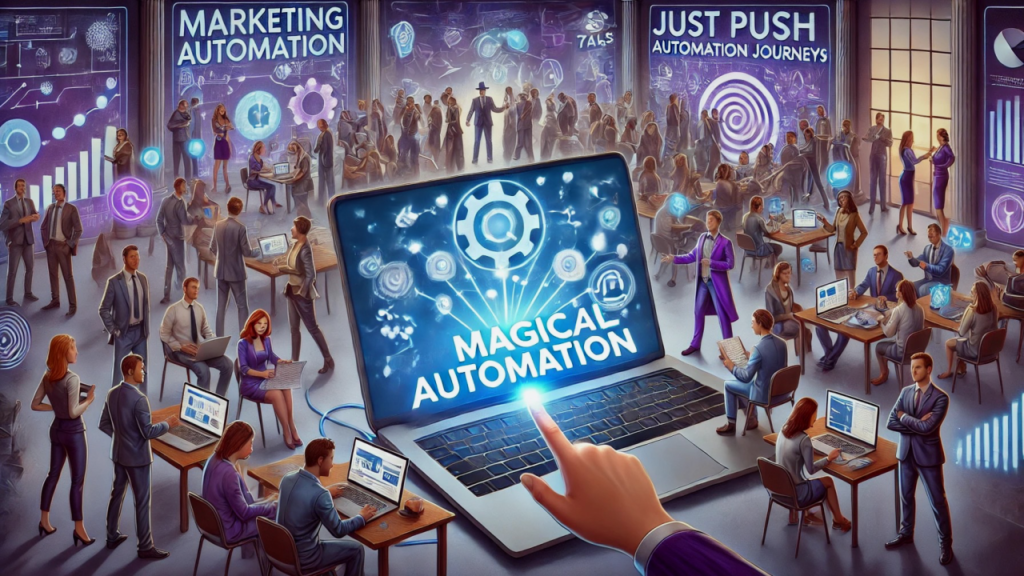
It’s easy to mistake “MA” for Magical Automation—ready to deliver hyper-personalised communication at the push of a button.
But it’s far from plug-and-play.
“In reality, it often takes a Marketing Army to automate your
marketing effectively.”
The Illusion of Automation
Well known MA platforms targeting both enterprise and SMBs are marketed as turnkey solutions, for seamless, personalised, automated communication. However, achieving basic functionality requires time, expertise, and budget. The vision of effortless, personalised communication is enticing but can be misleading. Without the guidance of human strategy, these platforms are sophisticated tools waiting for direction.
As I write this, even with advancements in AI, human oversight remains indispensable, for now at least. AI has yet to surpass human-led discovery, empathy, and planning. Today, MA’s true value lies in executing strategies crafted by those who understand both customers and the organisations serving them.
Why Human-led Strategy is Essential
Effective automation starts with strategists who combine empathy with data-driven insights. Their role is not only to understand what content resonates with customers but also to navigate internal organisational challenges. Many companies operate in silos, where Marketing, Sales, Customer Service, and CRM teams have competing priorities. This can often lead to overloading customers with too many communications, inconsistent tone and messaging, and confusion about what actions to take.
Strategists must work across teams to discover varying stakeholder objectives, resolve conflicting priorities, and create a hierarchy of communications that prioritises what customers truly need. By aligning internal teams and their goals holistically, they help ensure a seamless and cohesive customer experience
The Importance of Data, Content and those responsible for them
Even the best strategies can fail because of the following obstacles: Data and Content. Often, the required data doesn’t exist or is scattered across siloed systems, making it inaccessible for MA purposes. Collaboration with data specialists becomes crucial to identify, integrate, and prepare data for use within the MA platform. Without this groundwork, targeting, segmentation and personalisation efforts fall short.
On the content front, contextualisation and personalisation demand a significant amount of material as well as robust content strategies. Evergreen content can be reused, but highly targeted and dynamic personalisation requires fresh material. This requires careful planning, clear strategies, and sufficient resources. Content strategists must balance the need for fresh content with opportunities to repurpose existing assets. MA platforms can enable reusability, but it requires a well thought out plan and operational expertise to programme the delivery.
Building Automated Journeys
Automated journeys are one of MA’s key features, enabling communications triggered by user behaviours, actions, or time-based criteria. However, building these journeys is far from automatic. It involves strategic planning to map out triggers, timing, and cadence; expertise to design dynamic templates that adapt based on audience segments; and operational knowledge to implement and monitor the journeys effectively.
Consistency in visual brand and tonality is critical throughout these journeys, especially when involving dynamic content blocks that vary by segment or geography. Delivering this consistency requires input from strategists, designers, writers, data and technical teams, underscoring the human effort behind every piece of automation.
Avoiding the “Ideal” Strategy Trap
In the noble pursuit of great CX, I myself have fallen into the trap…
The trap of proposing exciting, ambitious strategies that stakeholders loved, then learning the hard way that they would ultimately be unachievable due to data, content or development resource limitations. Be clear on data availability and content creation capabilities first to avoid disappointment and stalled or down-scaled initiatives.
To avoid the trap, start small. Focus on manageable goals aligned with organisational capabilities. Evaluate both CapEx (initial investment) and OpEx (ongoing operational costs) to ensure the plan is not only feasible but sustainable over time. Consider a cross-organisational categorisation of “must-haves” “Low-hanging fruit” and “Quick wins”.
Human Oversight Makes Automation Work
Marketing Automation platforms are powerful tools, but they can’t yet replace the human expertise that makes them effective. From understanding customers and aligning internal teams to creating data-driven strategies and delivering high-quality content, success depends on thoughtful planning and execution.
Mishandled, MA can lead to poor user experiences, operational inefficiencies, and wasted resources. Done right, it can transform how organisations engage with their customers, increase lifetime value and build long-term loyalty.
Actionable Takeaway
When implementing Marketing Automation, keep these principles in mind:
- Start with strategy: Empathy and understanding should drive your approach.
- Align teams: Break down silos and prioritise organisational objectives.
- Invest in data and content: Ensure you have the resources needed to personalise effectively.
- Think long-term: Build a roadmap for iteration and growth.
- Communicate clearly: Set expectations with both stakeholders and end-users.
Marketing Automation is only as effective as the strategy behind it. With a CX-first mindset and a commitment to collaboration, Marketing Automation can deliver meaningful long-term engagement and support business growth.